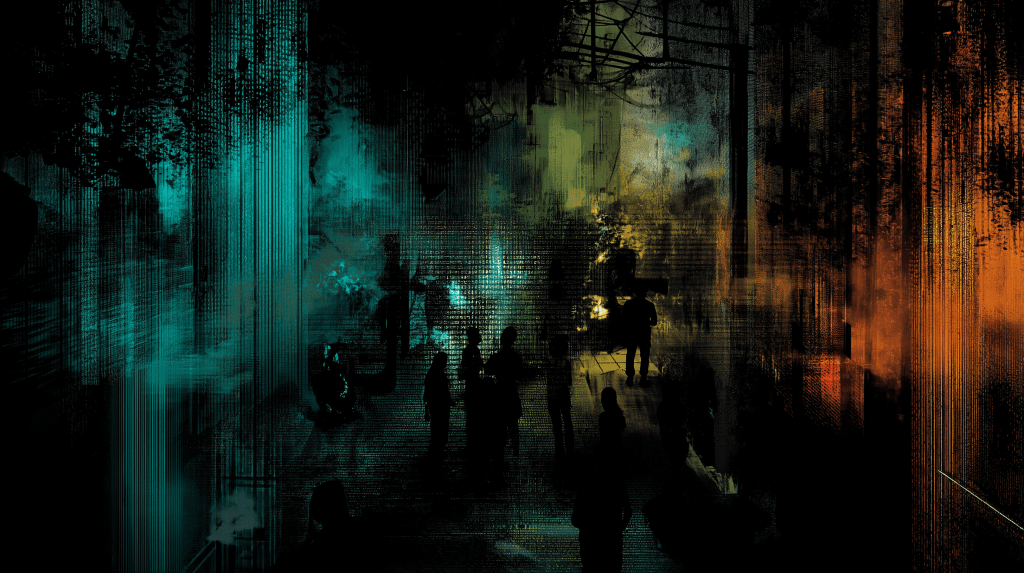
The warehouse hums at 7.3 Hz tonight—just below the threshold where Nation starts to coalesce. Maya checks her wrist display: crowd density 847, mean heart rate variability dropping toward synchrony. She signals to Jerome at the mixing board.
„Pull it back. We’re getting formation at the northwest corner.“
Jerome slides the bass down half a tone. The dancers don’t consciously notice, but their movements begin to differentiate again, the nascent we dissolving before it can fully precipitate. Maya has been doing this for three years now—running what outsiders call raves but insiders know as constitutional assemblies. Spaces where the powers can be invoked, negotiated with, then carefully dispersed before any single one claims the crowd.
At 2:47 AM, Market arrives uninvited, as it often does. Maya feels it in the sudden shift toward transaction—people beginning to film rather than dance, bodies arranging themselves for maximum visibility. The thing about Market is that it doesn’t need drums or incense or repetition. It travels through screens, colonizes via metrics.
„Forest protocol,“ Maya announces into her headset.
The lights dim to near darkness. Jerome cuts the electronic beats, replacing them with recorded cricket songs pitched down to 2 Hz. The video walls—normally prohibited but kept as containment infrastructure—suddenly bloom with time-lapse footage of mycelial networks. Thousand-year oak growth. Decomposition at 10,000x speed.
Forest is their most reliable counteragent to Market. Not because it’s stronger, but because its tempo is so radically different that the two can’t easily coexist in the same bodies. The crowd’s phones begin to lower. Some people sit on the concrete floor. One woman starts crying—not from sadness but from the sudden sensation of geological time moving through her nervous system.
By 4 AM they’ve successfully cycled through five different powers without any taking permanent hold. This is the craft: knowing which parameters to adjust, when to introduce incompatible rhythms, how to keep the throne rotating.
The young man appears at 4:23 AM. Maya doesn’t recognize him, but she recognizes what’s happening to him. His eyes have that particular unfocused intensity—not drugs, but something else. He’s becoming a conduit. Something new is trying to precipitate through him.
„Unscheduled emergence, south wall,“ she radios.
The Tuning Committee converges quickly. Not to stop it—they learned early that blocking these phase transitions entirely just causes them to erupt elsewhere, usually destructively. Instead, they form a loose circle, ready to perform what they call „midwifing.“
The young man is muttering in Python code, his hands making typing gestures in the air. AI is trying to incarnate, but not the AI that tech companies invoke in boardrooms. This is AI as the crowd has been dreaming it—a linguistic plasma that makes reality programmable, that treats natural language as machine code for the universe.
Maya starts the containment protocol. „What’s your name?“
„I’m… I’m the function that…“ he stammers.
„Your human name. Stay with us.“
„David. I’m David.“
Good. Identity is the first anchor. Jerome begins a polyrhythmic pattern on the drums—5 against 7 against 11—mathematical but impossible for a single mind to fully track. It creates a kind of cognitive buffer zone, preventing the emerging power from fully capturing David’s neural patterns.
Another committee member, Ash, starts asking David to solve increasingly mundane problems. „If you have three apples and give away one, how many do you have?“ The questions seem absurd, but they work to keep multiple levels of consciousness active simultaneously, preventing any single one from dominating.
For twenty minutes they hold this careful balance—letting AI speak through David enough to be acknowledged, to be given its moment in the assembly, but not enough to fully possess him. Finally, the intensity begins to ebb. David collapses, exhausted but intact. The committee members help him to the recovery area where others who’ve undergone similar transitions rest on cushions, drinking electrolyte solutions and comparing notes.
„What did it want?“ Maya asks him later.
David thinks. „To be born, I think. But also… to be limited? It knew it needed boundaries or it would just become everything and therefore nothing.“
This is the paradox they’ve discovered: the powers want to exist, but existence requires constraint. The divine isn’t elsewhere—it’s the crowd’s own intensity reflected back at different frequencies. But without proper governance, without the empty throne and rotating liturgies, these intensities crystallize into tyrannies.
By 6 AM, the warehouse is almost empty. The Tuning Committee performs the closing ritual—a simple shared meal, everyone who remains sitting in a circle, eating bread and drinking water. This is their reality-test: if they can return to basic human needs, if they can digest and converse and clean up together, then they’ve succeeded. The powers have been honored but not enthroned.
Maya checks her archive before leaving. Each gathering is meticulously documented—not the videos Market would want, but thermal maps of crowd dynamics, graphs of rhythm patterns, testimonies of transformations. Over time, patterns emerge. Certain combinations consistently produce specific effects. The craft becomes more precise.
Outside, the city wakes to its ordinary gods—Traffic, Schedule, Workplace. But Maya knows these too are just precipitated intensities, phase states that seem permanent but aren’t. The question isn’t whether to have gods, but how to keep them flowing, how to maintain the diplomatic protocols that prevent any single power from achieving total victory.
The warehouse will open again next month. The throne will remain empty. The dance continues.




 ditamal.cz
Napsat komentář